
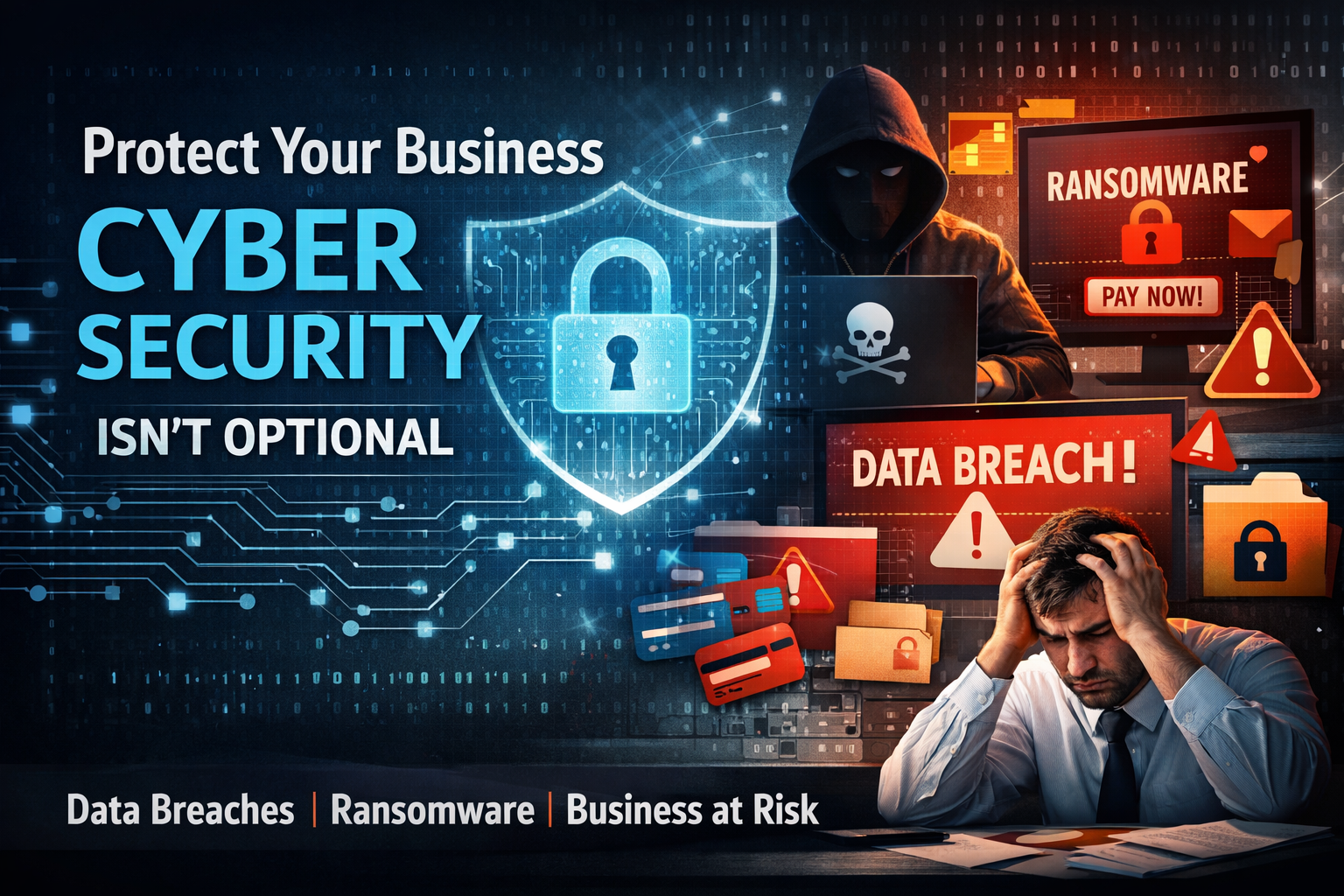
In today’s digitally driven world, your business’s computer systems are the backbone of every operation—from managing customer data and processing payments to storing proprietary information and enabling remote teams. But that connectivity comes with a cost: cybercriminals are constantly looking for ways to exploit vulnerabilities.
If you think “We’re too small to be targeted,” think again. Small and medium-sized businesses (SMBs) are increasingly in the crosshairs of attackers because they often lack enterprise-level defenses—making them easier targets. Qualysec+1
The Alarming Reality: Cyberattacks Are Common
- 43% of cyberattacks target small businesses, and nearly half of all these attacks focus directly on smaller companies. Qualysec
- According to industry data, 60% of small businesses that experience a cyberattack go out of business within six months due to the financial and operational strain. Qualysec
- Even just losing critical data—such as customer personal information, financial records, or proprietary business plans—can lead to permanent shutdown. StrongDM
- Nearly 40% of small businesses report losing crucial data after an attack, which can trigger lawsuits, regulatory penalties, and lost customer trust. StrongDM
These statistics aren’t scare tactics—they reflect a growing trend where cybercrime isn’t just a possibility; it’s a probability if your defenses aren’t strong. StrongDM
The Real Costs: Beyond Just Ransom
When a hacker gets into your systems, the consequences can extend far beyond immediate disruption:
- The **average total cost of a cyberattack on a small business can exceed $120,000–$254,000, including recovery expenses, fines, and reputational loss. bdemerson.com
- A ransomware attack can take your systems offline for days or weeks—the cost of lost business alone can be crippling. StrongDM
- Customers lose trust quickly: surveys show that over half of consumers are less likely to continue buying from a company that’s suffered a breach. StrongDM
And let’s be clear: paying a ransom isn’t a guaranteed fix. Recent data shows that many companies do pay, but still fail to recover all their data, while also inadvertently funding future attacks. TechRadar
What’s at Stake?
Here’s what organizations stand to lose when cybersecurity is ignored:
- Customer privacy and trust — Breaches often expose personal information like emails, passwords, payment details, and more.
- Proprietary data and competitive edge — Intellectual property or internal systems can be stolen or encrypted.
- Financial stability — From forensic investigations to regulatory fines and recovery costs, the bills add up fast.
- Reputation and brand loyalty — Customers remember data breaches long after systems are restored.
Why Proactive Security Matters
Investing in cybersecurity isn’t an optional expense—it’s a foundational part of doing business. A strong security posture helps you:
✔ Protect your customers and build trust
✔ Prevent costly downtime and data loss
✔ Comply with regulations (e.g., FTC, GDPR, PCI DSS)
✔ Avoid costly recovery efforts and potential lawsuits
Basic protections like firewalls, updated software, secure backups, employee training, strong passwords, multi-factor authentication (MFA), and endpoint security can drastically reduce your risk profile. The cost of prevention is almost always less than the cost of recovery.
Bottom line: Choosing to ignore cybersecurity risks is choosing to gamble with your business’s future. The statistics are stark—cyberattacks are common, often devastating, and sometimes fatal for small businesses. By taking even basic steps to protect your systems today, you not only safeguard your data, you protect your reputation, your customers, and your livelihood.
If you’d like, I can tailor this post with SEO keywords and meta elements for your WordPress blog (e.g., title, meta description, tags) to help it rank better in search results.
can you give me a version I copy and paste into wordpress
Absolutely 👍
Here’s a clean, copy-and-paste–ready version formatted for WordPress using standard headings, short paragraphs, and bold emphasis. You can paste this directly into the WordPress block editor (Visual or Code view).
Protect Your Business: Why Cybersecurity Isn’t Optional
In today’s digital world, your business computer systems are the backbone of daily operations. From customer records and financial data to proprietary information and internal communications, nearly everything your company relies on lives on a computer or server.
Unfortunately, that also makes your business a target.
Cybercriminals are no longer focused only on large corporations. Small and mid-sized businesses are now prime targets because attackers know many lack strong security controls. Ignoring cybersecurity risks can lead to stolen data, operational shutdowns, and—in many cases—the end of the business itself.
Cyberattacks Are More Common Than You Think
Many business owners believe they’re “too small” to be attacked. The data says otherwise:
- 43% of all cyberattacks target small businesses
- 60% of small businesses that suffer a cyberattack go out of business within six months
- Nearly 40% of small businesses lose critical data after an attack
- Ransomware attacks against businesses continue to rise every year, with attackers specifically targeting organizations with weak defenses
These numbers are not hypothetical. They represent real companies that lost customer trust, operational capability, or financial stability after a breach.
What Hackers Are After
When attackers gain access to your systems, they are typically looking for:
- Customer data – names, addresses, emails, payment information, and login credentials
- Proprietary business data – internal documents, pricing models, intellectual property, and trade secrets
- Financial leverage – encrypting your systems and demanding a ransom to restore access
Once this information is stolen or locked, the damage can be immediate and long-lasting.
The True Cost of a Cyberattack
The financial impact of a cyber incident goes far beyond the initial breach:
- The average cost of a cyberattack on a small business can exceed $120,000
- Ransomware attacks can shut down operations for days or weeks
- Many businesses that pay ransoms still do not recover all of their data
- Legal fees, regulatory fines, forensic investigations, and system recovery costs add up quickly
Even worse, customer trust is difficult to rebuild. Studies show many customers stop doing business with companies that fail to protect their personal information.
Why Backups Alone Aren’t Enough
Some businesses believe regular backups are all they need. While backups are essential, they are not a complete security strategy.
Attackers often:
- Delete or encrypt backups
- Steal data before encrypting systems
- Target cloud services and shared drives
Without proper security controls in place, backups may not protect you from data theft, downtime, or compliance violations.
The Importance of Proactive Cybersecurity
Cybersecurity is not just an IT issue—it’s a business survival issue.
A proactive security approach helps you:
- Protect customer and employee data
- Prevent costly downtime
- Reduce the risk of ransomware and data theft
- Maintain compliance with industry regulations
- Preserve your reputation and customer trust
Basic protections such as firewalls, endpoint security, regular updates, secure backups, multi-factor authentication, and employee security training dramatically reduce the risk of a successful attack.
Final Thoughts
The question is no longer if businesses will be targeted—it’s when. Cyberattacks are becoming more frequent, more sophisticated, and more damaging.
Investing in cybersecurity today is far less expensive than recovering from an attack tomorrow. Protecting your systems means protecting your customers, your data, and the future of your business.
Cybersecurity isn’t optional—it’s essential.